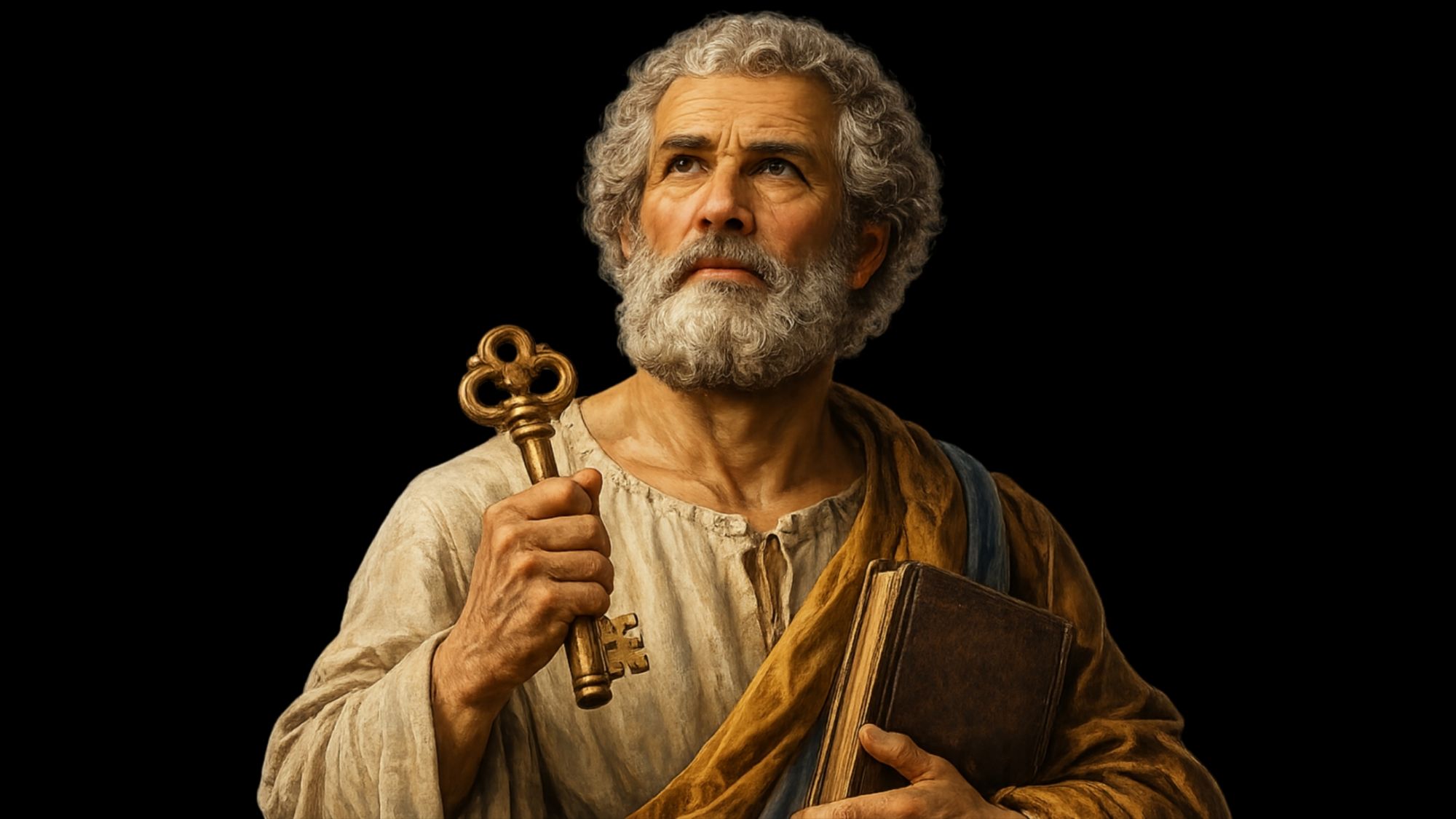
There is a striking parallel between Abraham and Peter, and this is supported by several biblical passages. The most significant is that both received a special blessing from God that established them as fathers of God’s people. Abraham became the father of many nations, while Peter was appointed the shepherd of Christ’s flock.
Beyond this special blessing, Abraham and Peter share several remarkable similarities. Both responded to God’s call with heroic faith, received a divine mission, were given new names, were promised victory over their enemies, and—perhaps most surprisingly—both are described as a “rock.”
Abraham and Peter Received a Special Blessing from God
In the passages below, God confers a unique blessing that elevates Abraham and Peter to a central role in salvation history. In Genesis, God the Father blesses Abraham to become the patriarch of the Old Covenant. In Matthew’s Gospel, God the Son blesses Peter to become the keeper of the keys of the Kingdom of Heaven. Christ entrusts Peter with the authority to bind and loose, making him His visible representative on earth. Thus, both Abraham and Peter were entrusted with a unique role in God’s plan of salvation.
“And he blessed him and said, ‘Blessed be Abram by God Most High, maker of heaven and earth; and blessed be God Most High, who has delivered your enemies into your hand!’ And Abram gave him a tenth of everything.”
Genesis 14:19–20 (RSV-CE)
“And Jesus answered him, ‘Blessed are you, Simon Bar-Jona! For flesh and blood has not revealed this to you, but my Father who is in heaven. And I tell you, you are Peter, and on this rock I will build my Church, and the gates of Hades shall not prevail against it.’”
Matthew 16:17–18 (RSV-CE)
They Responded Heroically to God’s Call
Genesis and the Letter to the Hebrews tell us that “by faith Abraham obeyed when he was called to go out to a place which he was to receive as an inheritance; and he went out, not knowing where he was to go” (Hebrews 11:8; Genesis 12:1–9).
Likewise, Peter was the first of the Apostles to answer Christ’s call to follow Him. After Jesus ascended into heaven, Peter, together with Paul, became one of the principal leaders of the early Christian Church, as witnessed by the New Testament and Sacred Tradition.
Both Received a Divine Mission
Just as Peter received the mission of holding the keys of the Kingdom, Abraham also received a unique mission from God:
“Now the LORD said to Abram, ‘Go from your country and your kindred and your father’s house to the land that I will show you. And I will make of you a great nation, and I will bless you, and make your name great, so that you will be a blessing. I will bless those who bless you, and him who curses you I will curse; and by you all the families of the earth shall bless themselves.’”
Genesis 12:1–3 (RSV-CE)
The Promise of Victory Over Enemies
Peter was assured that the gates of Hades would never prevail against Christ’s Church. Abraham likewise received a promise of victory over his enemies:
“I will indeed bless you, and I will multiply your descendants as the stars of heaven and as the sand which is on the seashore. And your descendants shall possess the gate of their enemies.”
Genesis 22:17 (RSV-CE)
Both Received New Names
In the Old Covenant, God changed Abram’s name to Abraham. In the New Covenant, Jesus changed Simon’s name to Peter (Petros in Greek, Cephas or Kepha in Aramaic).
“Behold, my covenant is with you, and you shall be the father of a multitude of nations. No longer shall your name be Abram, but your name shall be Abraham; for I have made you the father of a multitude of nations.”
Genesis 17:4–5 (RSV-CE)
Abraham and Peter as the “Rock”
Peter’s name, Petros, means “rock” or “stone” in Greek. In Aramaic, Jesus called him Kepha (Cephas), meaning a substantial rock suitable for a foundation.
Abraham, too, is associated with the image of a rock. Through the prophet Isaiah, God calls His people to look to Abraham as the “rock” from which they were hewn:
“Listen to me, you who pursue deliverance, you who seek the LORD; look to the rock from which you were hewn, and to the quarry from which you were dug. Look to Abraham your father and to Sarah who bore you; for when he was but one I called him, and I blessed him and made him many.”
Isaiah 51:1–2 (RSV-CE)
These parallels do not erase the differences between Abraham and Peter, but they reveal a beautiful continuity in God’s plan. Just as Abraham served as the visible father of God’s covenant people under the Old Covenant, Peter was appointed by Christ to serve as the visible shepherd and foundation of His Church under the New Covenant.
Just as Abraham’s fatherhood continued through the people of the Old Covenant, Peter’s Office continues through his successors, the popes. Christ entrusted Peter with His authority, not with personal perfection. Throughout the Church’s history, there have been both holy popes and sinful popes, wise popes and imprudent popes. Yet the Office itself remains a gift of Christ to His Church.
For this reason, Catholics are called to recognize and respect the Pope’s legitimate authority through obedience. Fidelity to the papacy is part of the Church’s DNA because Christ Himself established this office. At the same time, the Pope is not above Divine Revelation or Sacred Tradition. His authority exists to preserve and faithfully hand on the Deposit of Faith, not to change it.
For example, faithful Catholics should reject Fiducia Supplicans, particularly its permission for priests to give non-liturgical blessings to fornicating couples. While the document insists that it does not approve or legitimize sinful unions, it is in conflict with the Church’s constant teaching on marriage and sexual morality.
In situations like this, Catholics should continue to hold firmly to Sacred Tradition while maintaining respect for the Papal Office. Our fidelity is ultimately to the Office established Christ, who entrusted Peter and his successors with the task of safeguarding—not altering—the faith once delivered to the saints.




Leave a Reply