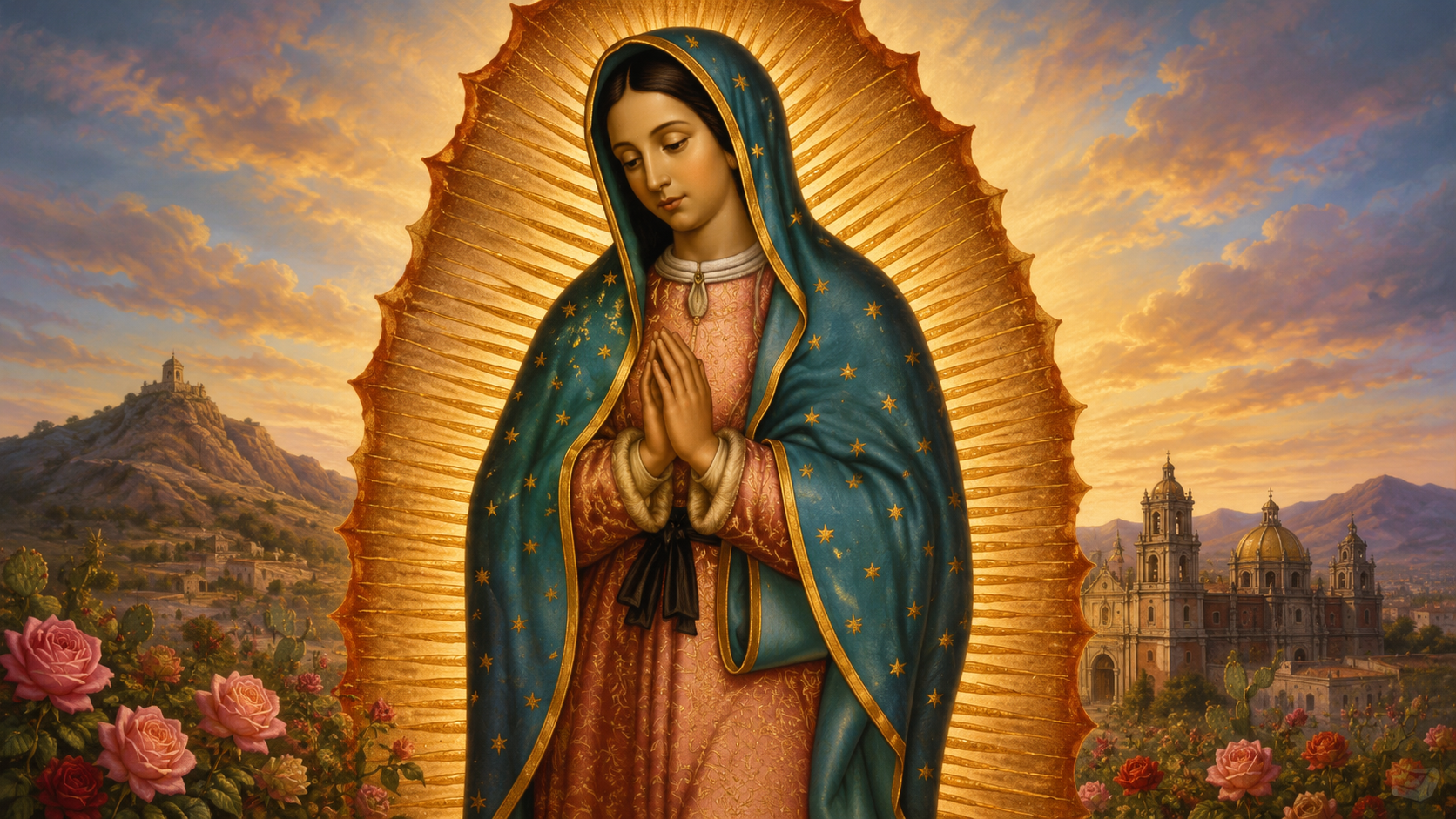
In the year 1531, on the hill of Tepeyac in Mexico City, the Blessed Virgin Mary appeared to a humble indigenous convert, Saint Juan Diego. She did not come speaking as a distant queen. She came speaking as a Mother.
At a time when millions were wounded by fear, suffering, poverty, and uncertainty, Our Lady gave words that continue to console souls nearly five centuries later. These are not cold theological statements. They are deeply personal invitations from Heaven itself.
Suggested Book
Taken from The Wonder of Guadalupe: The Story of the Miraculous Image of the Blessed Virgin in Mexico by Francis Johnston, these messages reveal the tenderness, authority, and maternal love of the Mother of God.
“What is the matter, my little child? Am I not here, who am your mother?”
This may be the most famous line ever spoken by Our Lady of Guadalupe — and perhaps one of the most comforting sentences in Christian history.
Mary does not begin with a command.
She begins with concern.
She speaks to Juan Diego not as a ruler addressing a subject, but as a mother calming a frightened child. In those few words, she reminds every Catholic that we are never abandoned. Even when the world feels chaotic, even when grief overwhelms us, Heaven has not forgotten us.
The phrase “Am I not here?” is especially powerful. Mary points away from fear and toward her presence. The message is simple: if the Mother given to us by Christ stands beside us, despair should never have the final word.
“I am your merciful Mother, of all mankind, of all those who love me, of those who cry to me, of those who have confidence in me.”
Our Lady of Guadalupe does not limit her motherhood to one nation, race, or language. She declares herself the Mother of all mankind.
This was revolutionary in 16th-century Mexico, where divisions between Spaniards and natives were severe. Mary appeared not as a European noblewoman, but with features and symbols that the indigenous people could recognize and love. She came as a mother gathering her children together.
Notice also whom she especially mentions. She speaks of those who love her, those who cry to her, and those who place their confidence in her. This is the heart of Marian devotion. Catholics do not turn to Mary because she replaces Christ, but because she leads souls to Him with the tenderness only a mother can give.
“Know for certain that I am the perfect and perpetual Virgin Mary, Mother of the True God, through whom everything lives, the Lord of all things, who is Master of Heaven and Earth.”
Here, Our Lady clearly identifies herself.
She is not merely a symbolic figure or vague spiritual presence. She is the Virgin Mary, Mother of the True God. Every authentic Marian apparition points toward Jesus Christ, and Guadalupe is no exception.
Mary’s words also destroy the modern idea that all religions are interchangeable. She proclaims the True God — the Creator, the Lord of Heaven and Earth.
In Mexico, where pagan worship and human sacrifice had once dominated, this declaration carried enormous weight. Through Guadalupe, millions converted to Christianity. The Mother came to bring souls to her Son.
“I will show and offer all my love, my compassion, my help, and my protection.”
Catholics often describe Mary as tender and loving, but here she herself promises those gifts directly.
Notice the beautiful progression in her words. She begins with love, then compassion, then help, and finally protection. Mary does not merely sympathize from afar. She actively helps her children. Throughout history, countless Catholics have testified to her intercession in moments of danger, illness, temptation, and despair.
Under the title of Our Lady of Guadalupe, she especially became a protector of the unborn, the poor, the suffering, and the forgotten.
“I will hear your weeping and your sorrows, and will remedy and alleviate your sufferings, necessities and misfortunes.”
This is one of the most deeply human promises in the Guadalupe story.
Mary acknowledges suffering without pretending it does not exist. She speaks directly about tears, sorrows, necessities, and misfortunes because she knows human life is filled with crosses.
Yet she also promises that our suffering is seen.
How many people today silently carry anxiety, loneliness, financial burdens, family wounds, or spiritual exhaustion? Our Lady reminds us that Heaven hears every cry whispered in prayer.
No sorrow is too small for a mother to notice.
“Listen to me, my dearest child, and understand that it is altogether necessary that you should be the one to undertake this mission.”
Juan Diego did not feel worthy. He tried to excuse himself and asked Mary to send someone more important.
But Our Lady chose him precisely because he was humble.
This is how God often works. He chooses the small, the weak, and the overlooked to accomplish His greatest works. Guadalupe itself became proof of that truth.
The message for modern Catholics is clear. Holiness is not reserved for celebrities, theologians, or powerful people. God can use ordinary souls who are willing to obey.
“Mark my words well, my little child. I shall richly reward you for all the worry, work, and trouble you have undertaken on my behalf.”
Mary recognizes sacrifice.
Many faithful Catholics today grow discouraged defending the faith, raising children in a hostile culture, remaining morally faithful, or persevering in prayer during spiritual dryness.
Our Lady’s words remind us that no sacrifice made for God is forgotten. Heaven sees every hidden act of fidelity, even when the world mocks it, misunderstands it, or ignores it entirely.
“Listen and let it penetrate your heart, my dear little child. Do not be troubled or weighed down with grief. Do not fear any illness or vexation, anxiety or pain.”
This message feels astonishingly relevant today.
Modern society is drowning in anxiety, fear, and emotional exhaustion. Yet Mary speaks with calm certainty. She does not say suffering will disappear instantly, but she tells us not to be conquered by fear.
Her words echo Christ Himself: “Let not your heart be troubled.”
The Christian life is not the absence of suffering. It is the presence of God in suffering.
“You are under my shadow and protection. I am your fountain of life. You are in the folds of my mantle.”
Few Marian lines are as poetic and comforting as this one.
To be beneath Mary’s mantle is an ancient Catholic image of spiritual protection. It signifies closeness, shelter, and maternal care.
In a harsh and unstable world, Our Lady offers refuge. Not escape from reality, but spiritual security in the midst of it.
Countless saints entrusted themselves completely to Mary because they understood that the safest path to Christ is through the Mother He Himself chose.
“Now that you have heard my words, my child, go and do everything as best as you can.”
After consolation comes mission.
Mary does not leave Juan Diego paralyzed in emotion. She sends him forth. Catholic devotion is never passive sentimentality. True love for Our Lady should strengthen us to live the faith courageously.
She asks not for perfection, but fidelity. Her instruction is simple: “Do everything as best as you can.”
That simple instruction can transform an entire spiritual life.
Why Guadalupe Still Matters
The message of Feast of Our Lady of Guadalupe is not trapped in the 16th century.
It speaks directly to the modern world — to the anxious, to the forgotten, to the suffering, to the sinner seeking mercy, and to every Catholic trying to remain faithful in confusing times.
Our Lady of Guadalupe did not come merely to leave behind a miraculous image. She came to remind humanity that we have a Mother who hears, protects, consoles, and leads souls to Jesus Christ.
And perhaps her most important message remains the simplest one:
“What is the matter, my little child? Am I not here, who am your mother?”
Suggested Book


Leave a Reply