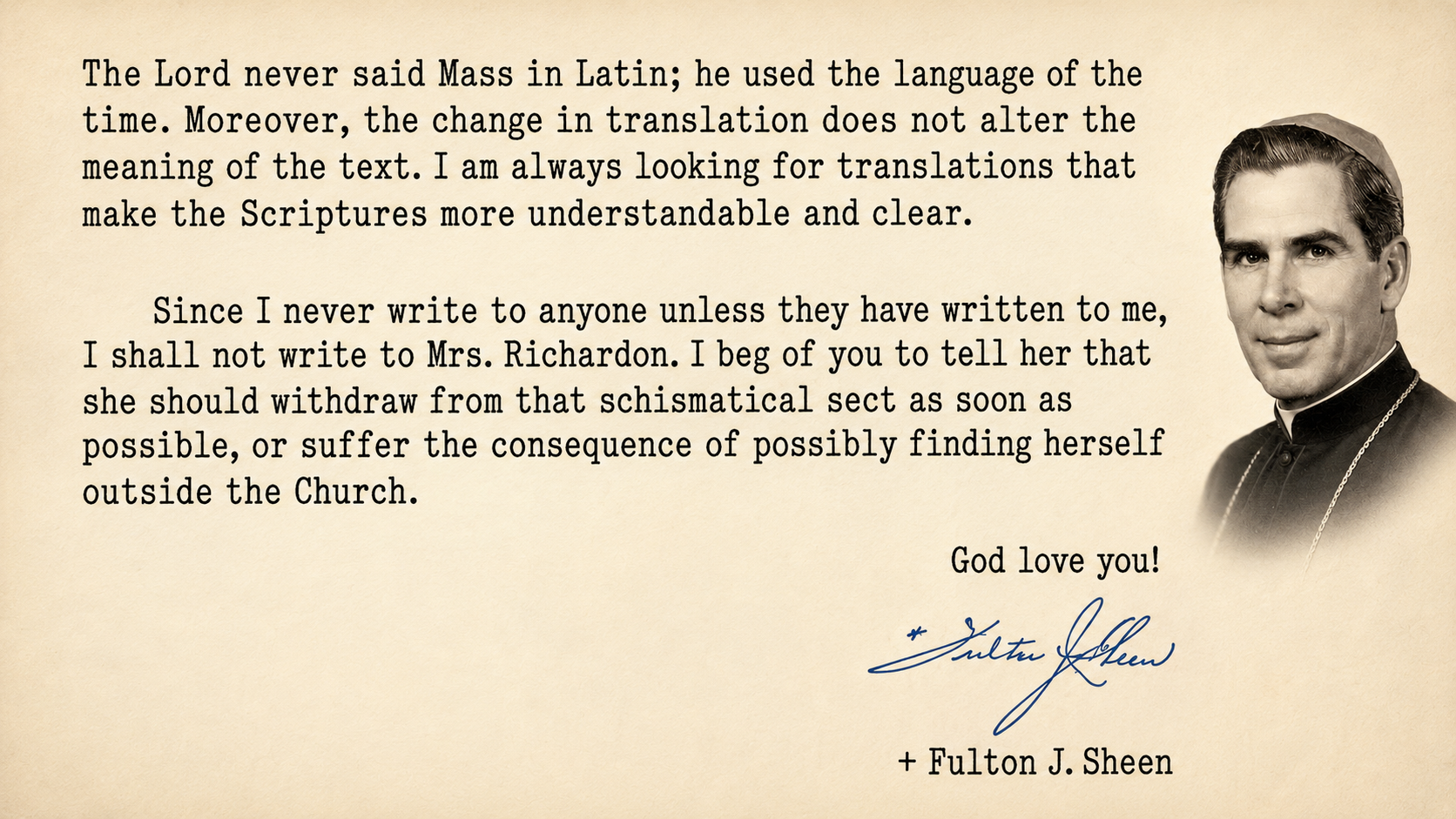
| September 21, 1978 Dear Barbara, I thank you for your kind letter and I admire you as the mother of eight small children. I am sure you are busy, but happy. If you have any influence on your friend I would beg you to influence her to leave the so-called Society of Saint Pius X. This group has no ecclesiastical approval, and indeed, it can lead her and possibly her family into schism and even heresy. The Vatican Council approved the updating of the Liturgy and among the changes were those recommended for the Mass. The changes made by Pope Paul VI were not doctrinal changes. they merely changed from Latin to the vernacular. There have been many changes in the Mass down through the centuries. The Lord never said Mass in Latin; He used the language of the time. Moreover, the change in translation does not alter the meaning of the text. I am always looking for translations that make the Scriptures more understandable and clear. Since I never write to anyone unless they have written to me, I shall not write to Mrs. Richardon. I beg of you to tell her that she should withdraw from that schismatic sect as soon as possible, or suffer the consequence of possibly finding herself outside the Church. God love you! Fulton J. Sheen |
How Catholics Should Understand Sheen on the SSPX
The 1978 letter of Archbishop Fulton J. Sheen regarding the SSPX should be understood within its historical context. At the time, Archbishop Marcel Lefebvre’s movement was already in serious conflict with Rome, and many bishops feared that attachment to the movement could eventually harden into rejection of ecclesiastical authority itself. Some of Sheen’s concerns proved justified over time, while others require more nuance when viewed from the perspective of today.
When Sheen urged Catholics to “leave the Society of Saint Pius X,” his warning was not entirely without basis. Catholics should not attend SSPX chapels because they believe Rome has defected from the Faith, that the Pope possesses no real authority, or that the Novus Ordo Mass is intrinsically evil or invalid. Such attitudes easily foster a schismatic mentality and can gradually lead people into rejecting legitimate Church authority altogether.
At the same time, there can be limited and sincere reasons why some Catholics shelter within SSPX communities. If no practically accessible Catholic chapel exists nearby, or if a person honestly and sincerely believes that the liturgical life available in surrounding parishes is spiritually harmful or seriously fails to nourish the soul of oneself and one’s family, then attendance at an SSPX chapel can be understandable.
This does not mean that every SSPX position is justified, nor does it excuse disobedience. It simply recognizes that many Catholics seek reverence, doctrinal clarity, and spiritual stability for their families.
Suggested Book: The Archbishop Fulton Sheen Signature Set
Sheen was substantially correct when he stated that the SSPX lacked ecclesiastical approval. Although the Society was founded in 1970, Rome withdrew its canonical recognition in 1975, and the SSPX has never fully regained regular canonical status since then.
In that sense, the SSPX never truly “rose” canonically after 1975; rather, it has remained in a continuing state of irregularity and tension with Church authorities. While Rome has granted limited faculties for confessions and certain marriages, the Society still lacks an ordinary canonical mission in the Church. This reality should not be minimized by defenders of the SSPX.
His warning that sheltering within the SSPX could lead to schism or even heresy also deserves serious consideration. Not every Catholic who attends SSPX chapels is schismatic. Many are ordinary faithful Catholics simply seeking a more reverent liturgical environment.
Nevertheless, prolonged immersion within SSPX circles can gradually shape one’s psychology and attitude toward the Church. When Catholics are constantly exposed to claims that Rome is corrupted, that bishops are unreliable, that the ordinary liturgy is spiritually dangerous, or that obedience can be suspended whenever one judges authority to be harmful, a mentality of suspicion can slowly take root.
Over time, some individuals begin defining Catholic identity primarily through opposition and resistance rather than communion. This pattern has repeatedly appeared in traditionalist movements. Groups that once seemed merely “traditional” eventually drifted further into rejection of ecclesiastical authority. The danger Sheen perceived was therefore not simply doctrinal, but psychological and spiritual as well.
At the same time, Sheen’s claim that the liturgical changes merely replaced Latin with the vernacular and did not substantially alter meaning is far less convincing today. It is true that the Mass did not become invalid because vernacular languages were introduced, and Latin itself is not what makes the Mass Catholic.
However, the postconciliar reform involved far more than translation. Numerous prayers were removed or simplified, ceremonial symbolism was reduced, and the overall atmosphere of worship changed dramatically in many places.
Still, Sheen’s historical context must be remembered. In the late 1960s and 1970s, many parishes still retained substantial continuity with older Catholic worship. Ad orientem celebration was still relatively common, Gregorian chant had not entirely disappeared, Communion on the tongue remained the norm, priestly vestments were still largely traditional, and the culture of reverence inherited from the older rite had not yet completely collapsed.
Sheen may therefore have genuinely perceived less rupture than Catholics perceive today. This is no longer the experience of many Catholics who compare the ordinary parish liturgy with the Traditional Latin Mass. Anyone accustomed only to the Novus Ordo who attends the traditional liturgy for the first time will immediately notice major differences in atmosphere, symbolism, silence, orientation, and theological emphasis.
Likewise, Sheen’s statement that “the Lord never said Mass in Latin” is true, but ultimately misses the central concern of most traditional Catholics. Catholics attached to the Traditional Latin Mass generally do not claim that Latin was spoken by Christ or that Latin itself possesses divine origin.
Their concern is rather that the older liturgical tradition nourishes the soul more deeply and expresses Catholic theology with greater clarity and reverence. The issue is therefore not whether Christ used Latin, but whether the liturgy developed through centuries of Catholic tradition more effectively preserves transcendence, sacrifice, silence, and doctrinal continuity. Catholics may legitimately prefer the older liturgy for those reasons.
Suggested Book: The Archbishop Fulton Sheen Signature Set
Finally, Sheen’s description of the SSPX as a “schismatic sect” requires the greatest nuance. Before 1988, the SSPX certainly existed in an irregular canonical condition, but it had not yet formally entered into schism.
The decisive rupture occurred in 1988, when Archbishop Lefebvre consecrated bishops at Écône despite explicit papal prohibition. Rome judged this act schismatic, and the bishops involved incurred excommunication.
In 2009, Pope Benedict XVI lifted those excommunications as an act of mercy and pastoral reconciliation. This did not mean that Rome approved SSPX disobedience or canonical irregularities, but rather that reconciliation remained possible.
At present, the SSPX is canonically irregular but not formally in schism. Nevertheless, the danger of schism remains real. If future episcopal consecrations proceed again against explicit papal directives, another rupture may occur.
In this sense, it is more accurate to say that the SSPX often manifests a schismatic tendency or mindset, even if it is not presently under a formal declaration of schism.
Catholics today should therefore neither dismiss Fulton J. Sheen nor treat his remarks as beyond criticism. He was correct to warn against extremism, habitual disobedience, and the spiritual dangers that emerge when Catholics define themselves primarily through resistance to ecclesiastical authority.
At the same time, many Catholics attached to traditional liturgy are not rebels seeking schism, but sincere faithful searching for reverence, doctrinal clarity, stability, and spiritual nourishment for their families amid widespread confusion and liturgical decline.
The balanced position is therefore to recognize both realities at once. Catholics should avoid treating the SSPX as the “true Church” over against Rome, while also acknowledging that many postconciliar liturgical developments have deeply troubled serious Catholics.
Love for Tradition must remain united with humility, charity, and recognition of legitimate authority, while defenders of the postconciliar Church must recognize that traditional Catholic concerns are often sincere and not merely products of rebellion.




Leave a Reply