“You shall not give any of your children to devote them by fire to Mo’lech… For whoever shall do any of these abominations, the persons that do them shall be cut off from among their people.” (Leviticus 18:21,29 RSV-NT)
Over the years, certain public controversies involving a Filipino drag performer—who considers himself a Roman Catholic—have drawn strong reactions from segments of the Catholic faithful in the Philippines. Some of his actions have been the subject of criticism and discussion among Catholics, including lay people and members of the clergy.
A spokesperson for the Catholic Bishops’ Conference of the Philippines has previously described certain actions in related controversies as blasphemous and as constituting a mockery of the Catholic faith. Archbishop Socrates Villegas has likewise, in public statements, echoed the concerns of many who viewed such actions as blasphemous and grossly disrespectful. These responses were seen by many as significant acknowledgments of the seriousness of the issue.
At the same time, these discussions have also raised broader questions among the faithful: how should the Church respond when public acts are perceived by many Catholics as offensive to the faith and when such controversies continue to generate scandal or confusion?
This reflection is not primarily about any single individual, but about the broader pastoral and canonical question of how the Church addresses public situations that many believers experience as troubling or confusing.
The issue is not whether Church authorities have spoken publicly. In some cases, statements have already been issued. The question that some faithful raise is whether public statements alone are always sufficient when controversies persist and when there is no clear public indication of clarification, reparation, or resolution.
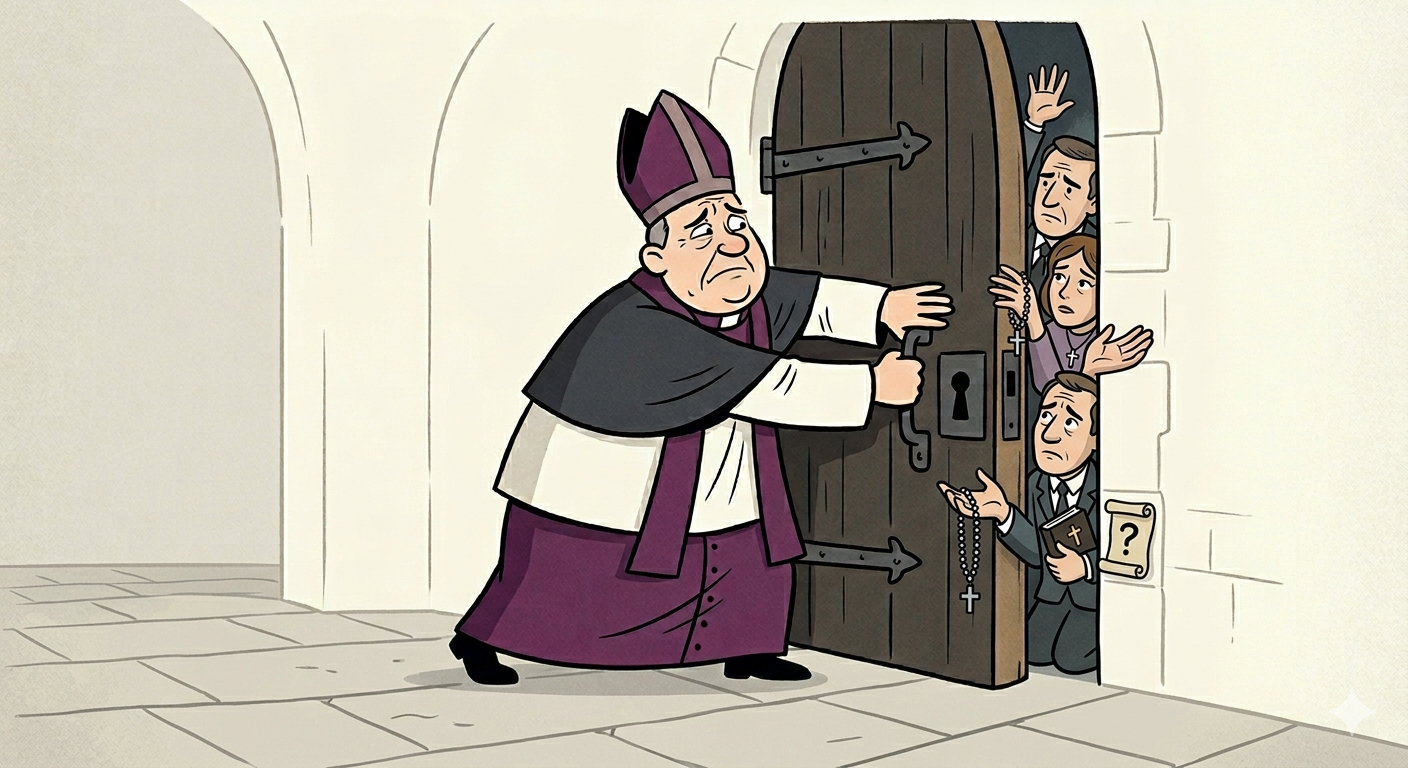
In other contexts, there have been instances where bishops have imposed canonical penalties in response to acts regarded as gravely offensive to the faith. This naturally raises a broader question for reflection: why does the Philippine Church appear hesitant to issue clear canonical warnings, and what factors may be influencing the reluctance to impose severe penalties, such as excommunication, in cases involving serious public offenses?
The Code of Canon Law does provide norms regarding offenses against religion and sacred things. Canon 1368 addresses public expressions of contempt for religion or the Church, while Canon 1369 speaks of actions that gravely harm good morals or religion in public contexts. These canons reflect the Church’s awareness that public acts can have spiritual consequences and may require proportionate responses.
Canonical penalties, including excommunication when applied, are understood in Catholic theology not as acts of vengeance, but as medicinal remedies. Their purpose is traditionally described as correction, the healing of scandal, and ultimately the salvation of souls.
A formal canonical declaration, when issued, can also serve to clarify ecclesial boundaries, reduce ambiguity among the faithful, and signal the seriousness with which the Church regards certain public acts. Conversely, when no formal clarification is issued in highly public controversies, some members of the faithful may experience confusion regarding the Church’s stance.
These reflections lead to a sincere question being asked in various circles: when public controversies continue to generate scandal in the absence of clear correction or resolution, how should the Church balance pastoral discretion, mercy, justice, and the need to safeguard the faith of the faithful?
This is not posed as a challenge, but as a concern expressed by some Catholics who desire clarity and consistency in how the Church responds to public issues affecting the faith.
It is also worth remembering that bishops carry a serious pastoral responsibility in discerning each situation. Their judgments must take into account justice, mercy, repentance, the good of souls, and the wider impact on the Church’s witness. These are complex responsibilities that are not easily reduced to simple answers.
Nevertheless, it remains a legitimate area of reflection for Catholics to ask how canonical norms are applied in practice when public controversies cause widespread discussion or confusion. Such inquiry, when made respectfully, is part of the Church’s life of accountability and concern for truth (Can. 212).
Ultimately, Catholics should agree that anything perceived as disrespectful toward God or sacred realities is a serious matter for discernment and pastoral care, and that the Church’s response should always be guided by truth, charity, and the salvation of souls.


Leave a Reply