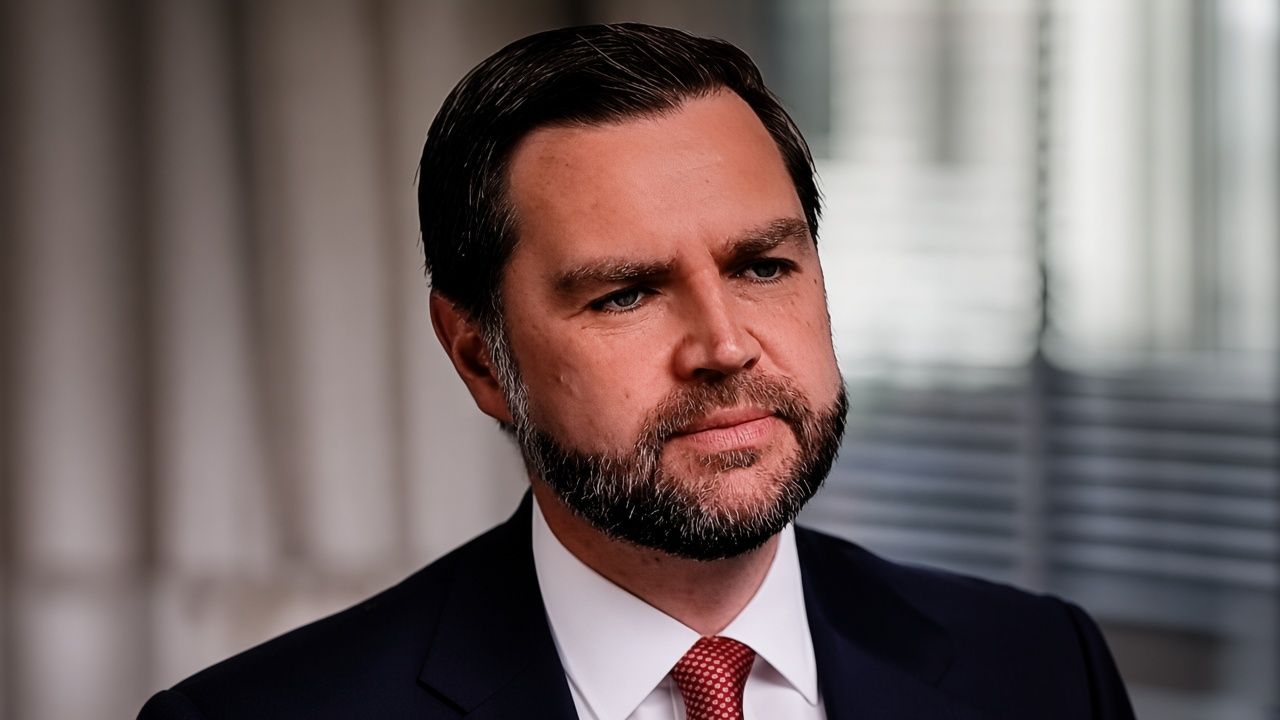
In an interview with Raymond Arroyo, U.S. Vice President JD Vance discussed several issues affecting Christians and Western society, including the death penalty, abortion, immigration, and the future of France. His answers will not settle the disagreements Christians have about these issues. Nevertheless, his remarks reveal a politician who appeals to Christian principles while asking Church leaders for clearer explanations on difficult questions.
He also spoke about his book “Communion: Finding My Way Back to Faith” and the personal experiences that helped lead him back to the Catholic faith. His account of returning to the faith also shows that his Catholicism developed through both intellectual reflection and personal experience.
Vance on the Death Penalty
Arroyo asked Vance whether he agreed with the claim that supporting the death penalty was incompatible with being pro-life, referring to statements by the Pope and bishops.
Vance answered honestly: “I think this is a very tough issue, Raymond. I’ll be honest with you. I’m very uncomfortable with the death penalty, especially, you know, you have all this litigation. It’s very expensive.”
However, he also pointed to the history of Church teaching. “If you go back to ancient church doctrine, or even what Popes were saying 100 years ago, there was a recognition that for the most heinous crimes in the world, that was a just punishment,” he said.
Vance admitted that he finds the issue particularly difficult because he understands Church doctrine to have consistency across generations. He therefore called on Church leaders to explain how the traditional recognition of capital punishment can be understood alongside the problems of its modern use.
Vance on Abortion
Vance was more direct when Arroyo asked him about a politician’s claim that the Bible is silent on abortion.
Vance referred to the Book of Jeremiah, saying, “I believe it’s in the book of Jeremiah that I knew you when you were formed in the womb.” He argued that human beings are not merely biological entities but also spiritual beings, and that Christians recognize human life as beginning at conception.
He called the claim that the Bible has nothing to say about unborn life “a ridiculous thing” to say. For Vance, the defense of unborn children is not based only on a particular biblical passage. He also appealed to the moral understanding God gives human beings.
At the same time, he acknowledged that pregnancy can present difficult circumstances for women. He argued that Christians should ask how society can make it easier for women to choose life when they face concerns about their careers, relationships, or future.
“Our argument as conservatives, but more importantly as Christians, should be why don’t we make it as easy as possible for that woman to choose life,” he said.
His argument is that defending life requires both recognizing the dignity of the unborn and creating a culture that supports women and families.
Immigration and the Church
On immigration, Vance argued that Christian charity and border security should not be treated as opposing principles. He said, “You must be welcoming towards the stranger. On the other hand, nations are allowed to control their borders.”
For Vance, the difficult questions concern how these principles should be applied in practice. He asked how governments could welcome newcomers while protecting social trust and ensuring that immigration does not undermine the wages of native workers.
He also criticized what he considers vague guidance from Church leaders on modern mass migration. Vance recalled the message he received from Vatican officials: “Of course you’re allowed to protect your borders. We just want you to express humanity.” His response was, “Well, of course we want to express humanity. We also have to protect our borders.”
He believes Church leaders should offer more specific guidance on applying Christian principles to modern immigration challenges. His position is that governments must balance their duty to treat migrants humanely with their responsibility to protect their citizens.
Vance on France
Arroyo also asked Vance about France and the fear of “civilizational death,” a concern discussed in Vance’s book. Vance clarified that he would not describe France as experiencing civilizational death, but he did believe the country faced “real civilizational risk.”
He expressed concern about the world his children would inherit, saying he feared leaving them a society worse than the one he had received. He pointed to images of historic French buildings being burned and worried that people were questioning whether their country was becoming worse for future generations.
Vance believes France needs to recover its Christian roots. He said, “If France returns to its Christian roots, it can be welcoming to the stranger. It can also protect its borders in a way that preserves its civilization.”
For Vance, Christianity can provide the moral foundation for both welcoming others and preserving a nation’s cultural identity. He sees no necessary contradiction between these responsibilities.
Vance on His Book “Communion”
Arroyo also discussed Vance’s book, which he had read closely. Rather than seeing it simply as an intellectual conversion, Arroyo focused on the personal experiences that helped lead Vance toward Christianity.
Vance recalled a frightening incident after the funeral of his grandmother. While driving along a mountain road, his car began to spin out of control. He feared that he would go over the side of the mountain, but the car came to a stop. Vance described the experience in these words: “Like God put his hand on that car and made it stop.”
He admitted that he did not understand the experience at the time, but it remained with him. After going through periods of Christianity and atheism, he was baptized a Catholic.
Vance also spoke about the influence of C.S. Lewis, J.R.R. Tolkien, and the example of Christians, many of them Catholics, who seemed to possess a faith he had not yet fully understood. As Vance explained, “God doesn’t ask you to always understand things. He doesn’t even always ask you to always agree with him. But what he asks you is to be humble in the face of that uncertainty.”
His conversion, therefore, was not simply a matter of intellectual arguments. It involved experiences, questions, doubt, and a gradual movement toward Christ.
You can purchase his book “Communion: Finding My Way Back to Faith” here.





Leave a Reply