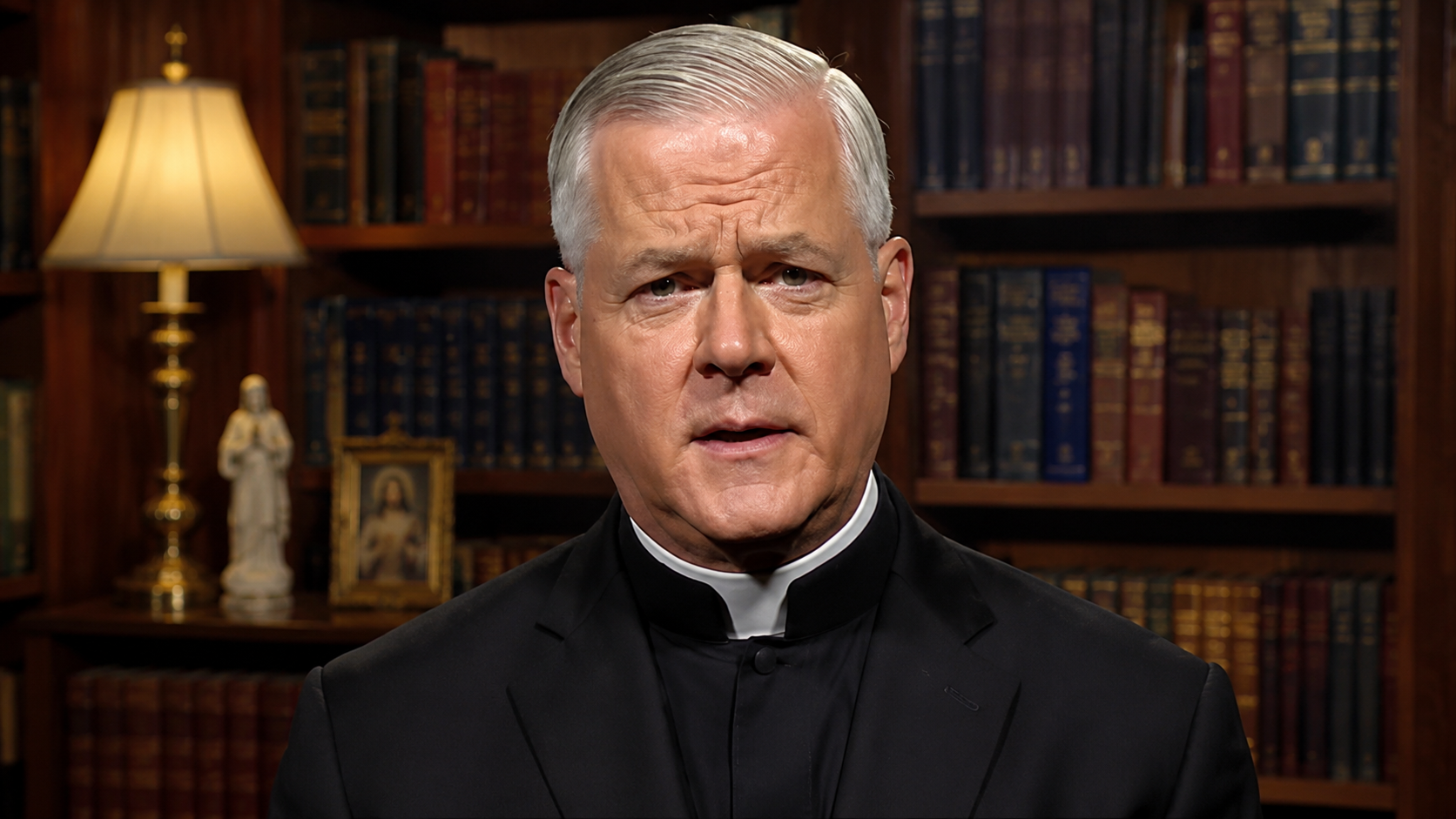
The pontificate of Pope Francis remains one of the most debated periods in recent Catholic Church history. For some Catholics, his leadership represented a renewed emphasis on mercy, dialogue, and care for those on the margins. For others, it brought serious questions about doctrinal clarity, Church discipline, and the proper understanding of Catholic teaching. Father Gerald E. Murray seeks to examine these concerns in his forthcoming book, A Papacy of Confusion: The Controversial Legacy of Pope Francis, published by TAN Books.
Father Murray explained that the book grew out of columns he wrote as the Francis pontificate unfolded. Robert Royal, editor-in-chief of The Catholic Thing, encouraged him to begin writing about Church affairs after they met in Rome. What began as commentary on current events eventually became a historical account of the decisions, statements, and controversies that shaped the twelve-year pontificate.
Unlike a book written entirely after Pope Francis’s death, Murray’s work draws on observations made while events were happening. As he explained in the Prayerful Posse episode released 10Oct26, the editor brought the columns together and arranged them so they read as chapters rather than as separate articles. This approach allows readers to follow the development of controversies, see how the pope responded to criticism, and examine how cardinals, bishops, and theologians interpreted or implemented his policies.
One important question raised by the book is how Catholic teaching is preserved when controversial statements or decisions create uncertainty among the faithful. Murray argues that the problems of the Francis years cannot be understood by examining the pope’s words alone. The responses of Church leaders, the handling of disagreement, and the practical effects of Vatican decisions must also be considered.
The debate surrounding Amoris Laetitia, Pope Francis’s 2016 apostolic exhortation on love in the family, is a major example. The document prompted controversy over the pastoral treatment of Catholics who are divorced and civilly remarried, particularly concerning access to Holy Communion. In the same interview, Murray revisited the disputed passages and the unanswered questions, known as the dubia, submitted by four cardinals. He argued that pastoral care must take human weakness seriously without suggesting that God’s commandments cease to apply to people facing difficult circumstances.
Murray also discussed the 2014 Synod of Bishops, where certain controversial paragraphs did not receive the required two-thirds majority but were nevertheless included in the final report. He sees this episode as an example of why the Church’s decision-making processes deserve careful historical examination. His wider concern is that consultation should allow genuine discussion rather than simply produce agreement with a predetermined direction.

The book also looks beyond individual controversies to the wider question of synodality and Church governance. Murray expresses concern that synodal processes could become a means of promoting changes to established Catholic teaching rather than helping bishops determine how best to proclaim and apply that teaching. Readers will encounter his arguments about the relationship between the papacy, the episcopate, theological debate, and the Church’s responsibility to preserve the faith received from Christ.
The importance of such a book lies partly in its historical value. Public debates often move quickly, and details of earlier controversies can easily be forgotten. By gathering contemporary commentaries into one volume, Murray offers readers a way to revisit the events in their original context and consider how individual decisions formed part of a larger pattern. Whether readers agree with his conclusions or not, the questions he raises about doctrine, governance, and accountability deserve to be examined carefully.
This makes the book particularly relevant to Catholics who want to understand the Francis pontificate beyond headlines and social-media arguments. It can also serve as a reference for future discussions about how the Church should respond when pastoral initiatives appear to conflict with established teaching. A serious assessment should distinguish between legitimate development, differing pastoral approaches, and genuine contradictions. It should also examine evidence fairly rather than assume that every disputed decision was necessarily motivated by bad intentions.
The book can be read alongside other critical assessments of Pope Francis’s pontificate. One is The Disastrous Pontificate by Dominic J. Grigio, published by Os Justi Press in 2025. At 876 pages, it compares Pope Francis’s statements and decisions with Scripture, Sacred Tradition, and the Church’s established teaching. Father Murray himself endorsed the book, describing it as a detailed examination of statements and decisions that he believes conflict with Catholic doctrine and the Church’s historic practice.
Another related work is The Dictator Pope by Henry Sire, published under the pen name Marcantonio Colonna. First published in 2017, it focuses on the leadership style, internal politics, and exercise of authority during the early years of Francis’s pontificate. These books approach the subject differently. The Dictator Pope emphasizes the pope’s leadership and Vatican politics, while The Disastrous Pontificate offers an extensive comparison of his actions and statements with traditional Catholic teaching. Murray’s book adds a contemporary record of controversies as they developed, making it useful for readers interested in both the events and their wider implications.
Murray has also written Calming the Storm: Navigating the Crises Facing the Catholic Church and Society, published in 2022 with Vatican journalist Diane Montagna. This earlier book takes the form of a wide-ranging interview examining challenges facing the Church and society, including marriage, the reception of Holy Communion, the Traditional Latin Mass, gender ideology, and the responsibility of bishops to uphold Catholic teaching. While Calming the Storm examines the roots of the crisis and ways Catholics can respond faithfully, A Papacy of Confusion looks more closely at the historical course and legacy of Pope Francis’s pontificate.
Father Gerald E. Murray is a priest of the Archdiocese of New York, a canon lawyer, and a longtime commentator on Catholic affairs. He was ordained in 1984 and later earned a doctorate in canon law from the Pontifical Gregorian University in Rome in 1998. He has served as a parish priest and has become widely known through his appearances on EWTN’s The World Over with Raymond Arroyo, where he regularly joins Robert Royal to discuss developments in the Church. He also writes for The Catholic Thing.
Books Mentioned in this Article
- A Papacy of Confusion: The Controversial Legacy of Pope Francis by Fr. Gerald Murray
- The Disastrous Pontificate by Dominic J. Grigio
- The Dictator Pope by Marcantonio Colonna
- Calming the Storm: Navigating the Crises Facing the Catholic Church and Society by Fr. Gerald Murray and Diane Montagna




Leave a Reply