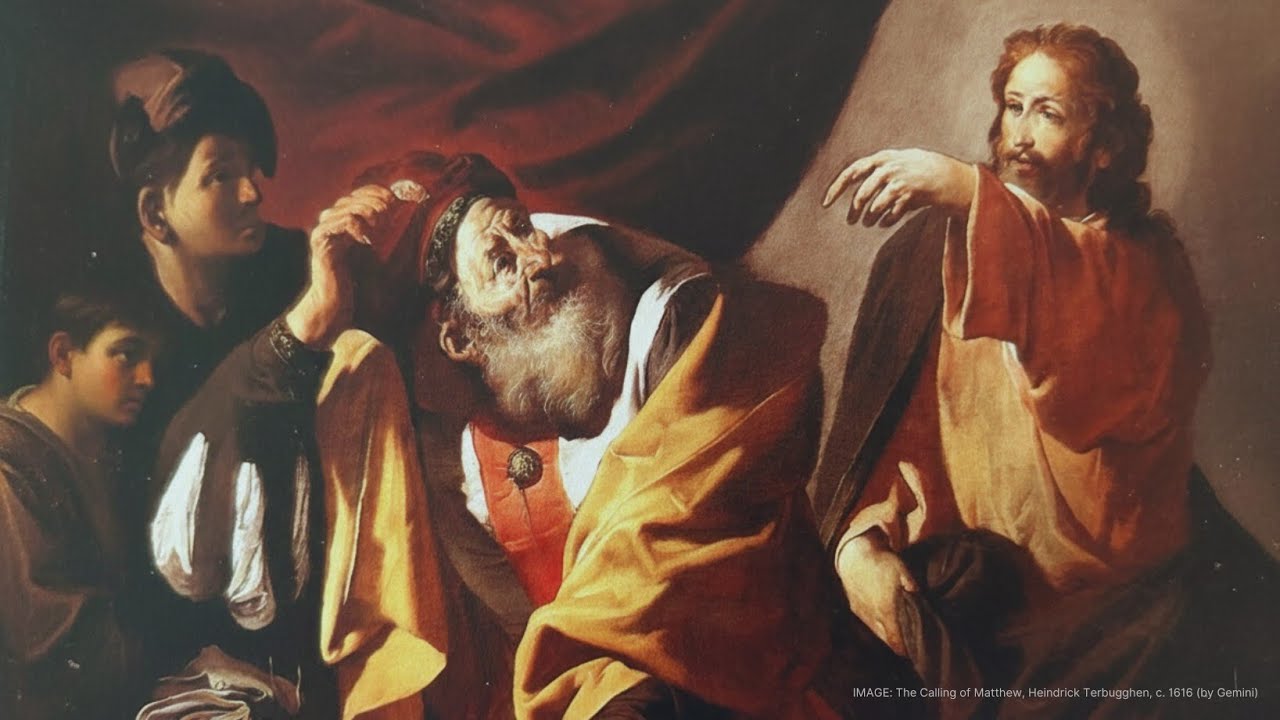
Saint Matthew, also called Levi, was once a tax collector but became an Apostle, Evangelist, and Martyr. His life reminds us that Christ calls even the most unlikely of men to holiness. Below are nine important things to know about him, drawn from Scripture and Tradition.
Mentioned Five Times in the Bible
Saint Matthew is mentioned only five times in the New Testament. First in Matthew 9:9, when Jesus called him at the tax office, and then four times in the lists of Apostles: Luke 6:15, Mark 3:18, Matthew 10:3, and Acts 1:13. Though little is said of him directly, his Gospel tells us much about the Kingdom of God.
He Had Two Names
The Gospels also call him Levi (Mark 2:14, Luke 5:27). This shows that he had two names: Levi, his Jewish name, and Matthew, which means “Gift of God.” His Christian name became the one by which the Church remembers him forever.
He Was a Tax Collector
Matthew was a publican in Capharnaum, gathering duties for Herod Antipas. Tax collectors were despised as sinners and traitors, yet Jesus looked at him with mercy and said: “Follow me.” Immediately, Matthew rose and left everything behind. Later he held a banquet in his home, where Jesus sat with tax collectors and sinners (Luke 5:29). The Pharisees complained, but Christ answered: “I came not to call the just, but sinners.”
Called Directly by Jesus
Unlike others who first heard Jesus preach, Matthew was called in the middle of his work. He was literally “sitting in the custom house” when Jesus spoke to him (Matthew 9:9). This shows that Christ does not wait for us to become perfect before calling us; He calls us as we are, and then transforms us.
He Preached Beyond Judea
After Pentecost, Matthew preached first in Judea, then farther into mission lands. Ancient traditions say he went to Ethiopia to the south of the Caspian Sea (not the African Ethiopia), and also to Persia, Parthia, Macedonia, and Syria. He obeyed Christ’s command to bring the Gospel to all nations (Matthew 28:19).
His Martyrdom
Tradition tells us that in Ethiopia, Matthew converted Ephigenia, the daughter of King Egippus, consecrating her as a nun. The next king, Hirtacus, lusted after her and asked Matthew to persuade her to marry him. Instead, Matthew rebuked him at the altar, declaring that she was already the bride of Christ. Enraged, Hirtacus ordered Matthew slain on the spot, making him a martyr for truth and purity.
His Relics in Salerno, Italy
There is disagreement about the exact manner of his death—whether by fire, stoning, or the sword. But the Church holds that in 954 AD, his relics were brought from Ethiopia to Salerno, Italy, where they remain today in the crypt of the Cathedral of Saint Matthew. Pilgrims venerate him there, seeking his intercession.
His Feast and Symbol
The Latin Church celebrates St. Matthew on 21 September, while the Greek Church honors him on 16 November. In sacred art, he is symbolized by a winged man, recalling his Gospel’s focus on Christ’s human lineage. He is also often shown with a lance, the emblem of his martyrdom.
His Gospel
The Gospel of Matthew is sometimes called the Gospel of the Kingdom. It emphasizes the Beatitudes, the Sermon on the Mount, and care for the poor and little ones. It closes with a powerful warning in the Judgment of the Nations (Matthew 25:31–46), where Christ separates the sheep from the goats. Saint Matthew reminds us that how we treat the least of our brothers will be how Christ judges us.
Saint Matthew’s journey, from despised tax collector to Apostle, Evangelist, and Martyr, shows the transforming power of God’s call. He teaches us that no sinner is beyond Christ’s mercy, but also that discipleship demands sacrifice, even unto death. Let us honor him by reading his Gospel, living out its lessons, and preparing for the Final Judgment it so vividly describes.



Leave a Reply