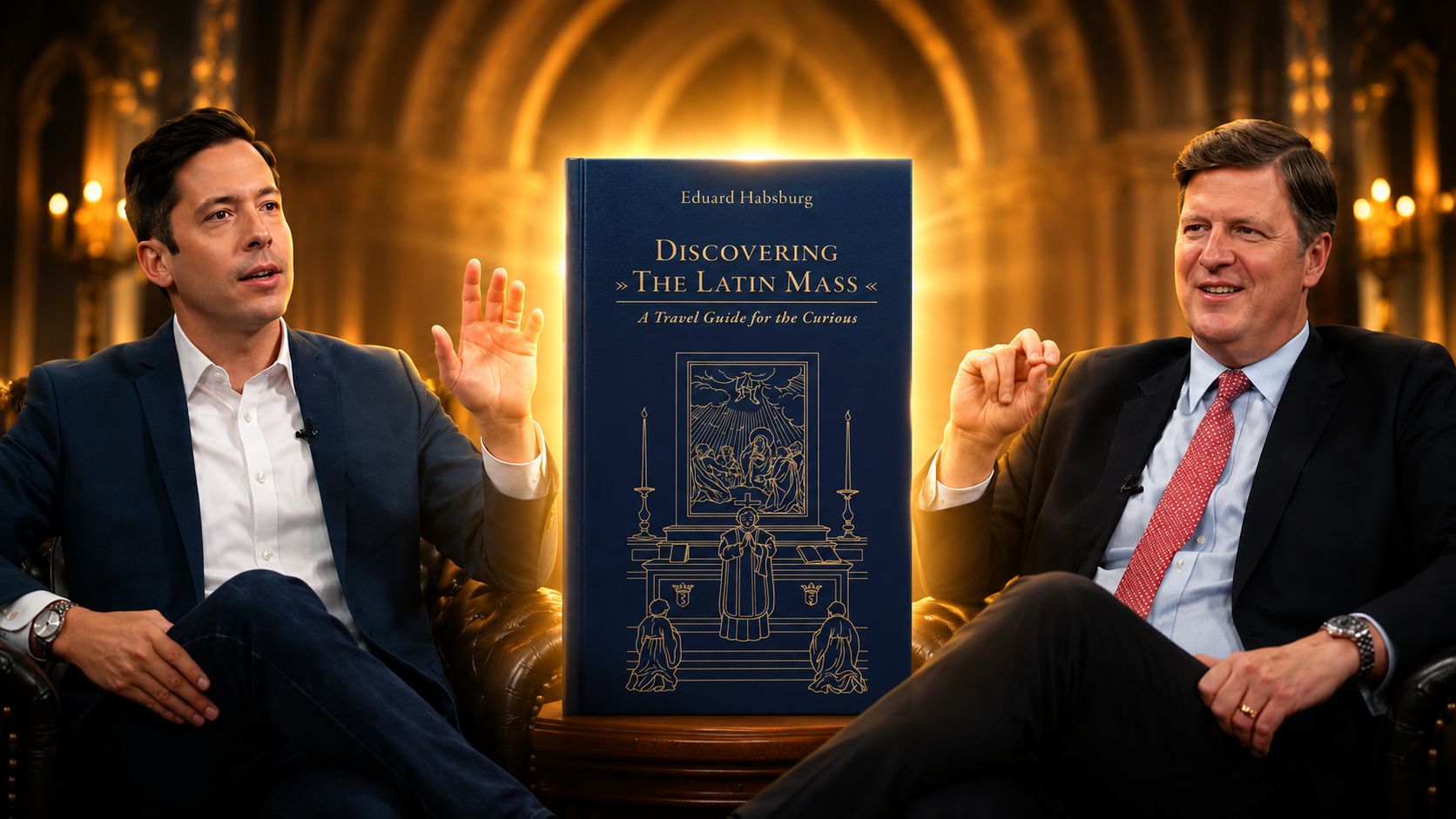
On July 26, 2026, Michael Knowles released an interview with His Imperial and Royal Highness Eduard Habsburg (former Hungarian Ambassador to the Holy See). The two discussed the beauty, reverence, and growing popularity of the Traditional Latin Mass (TLM)—particularly among young people and men.
Habsburg openly shared his own initial skepticism toward the Latin Mass and explained how he eventually came to appreciate its deep silence, rich tradition, and spiritual structure. They also touched upon the liturgical changes following Vatican II, the misunderstandings surrounding traditional Catholics, and the early days of the papacy under Pope Leo XIV.
Featured Book: Discovering the Latin Mass
Whether you are curious about traditional Catholic liturgy, feel overwhelmed by the idea of a service in Latin, or are looking for a straightforward guide to help you navigate it, Archduke Eduard Habsburg wrote Discovering the Latin Mass for you!
Designed as a light, accessible “hitchhiker’s guide” to the Traditional Latin Mass, this book breaks down what to expect during the liturgy, how to follow along without feeling lost, and the rich history, silence, and reverence that have shaped saints for over a millennium.
Published by Sophia Institute Press, this booklet is available through the Sophia Institute website. You can also purchase a copy through Amazon. If you prefer immediate access, subscribe to Sophia Institute’s Saintifi app, where you can read or listen to the booklet. It is also available in Kindle and Audible editions through Amazon.
Note: Although Knowles, Habsburg, and Sophia Institute have stated that the booklet is free (with only shipping costs), Sophia Institute’s website does not currently confirm this or provide promotion details. To avoid confusion, I have removed that claim and will update this article once further information is available.
Full Interview Transcript
Michael Knowles: An Austrian and an American walk into a studio and all we want to talk about is Latin. I am joined today by my friend, His Imperial and Royal ss Eduard of Austria, who you’ve met before when we had Eduard Habsburg on to talk about his previous book, The Habsburg Way. And now he is on to talk about, dare I say, an even more exciting subject, the Traditional Latin Mass. Eduard, thank you for being here.
Eduard Habsburg: Thank you for hosting me.
Michael Knowles: So, I tell the audience a lot about how much I love the Latin Mass. You obviously are quite a devotee of the Latin Mass. You’ve had some real first-hand experience around the Holy See as the Hungarian Ambassador to the Holy See. Congratulations on your retirement after 10 years of service. The question that I get from the people who are a little curious or they say, “Why would I want to go to church in Latin? Why is it so important that I go hear the Mass in Latin? Why do you weird trads care so much about this dead language?” What say you?
Eduard Habsburg: Well, that’s a long story, but the short version is because this is the liturgy that all our ancestors, all the great saints of the church from Gregory the Great via Saint Teresa of Avila, via all the great saints celebrated liturgy in this form. And I have to say I understand the sentiment. Why should I go to a Latin Mass I don’t even understand what the priest says? Because I for 50 years just went to our normal Mass today and I grew up in this. I loved today’s Mass. It shaped me. It made me the Catholic I am today. And twice I stumbled into a Latin Mass and that was both times rather catastrophic, because I went in there without preparation, without explanation, and without an idea what I was going to experience, and I came out afterwards and said, “This is the weirdest thing I’ve ever experienced in a church. Never again.”
Michael Knowles: Because it’s funny you say that. A lot of people, myself included, will say we’re raised in the modern liturgy. Sometimes it has acoustic guitars and all kinds of craziness. And but then when we found the Latin Mass, I said, “This is it. This is it. I’m home.” It clicked instantly. I loved it. You walk in and you say actually, “You know what? This is totally nuts and I have no use for it.”
Eduard Habsburg: Yes, I think that the majority of people, at least in Western Europe where I live, would react my way. But I hear stories of people walking into one of these things and being blown away and saying, “That’s it.” I never experienced it that way. For me, I did try it twice and I said never again, because it’s very alien. It presses different buttons on your senses, in your ears, in your eyes. The priest looks away from you. You see mostly his back. He moves in a very ritualized way, like on rails. He has no choice, no improvisation. He never turns to you and says, “The Lord be with you.”
Michael Knowles: Right.
Eduard Habsburg: But it’s all in Latin and away from you. So it’s alien. In a way, a friend once said it’s like if you have your walk in a park and then somebody takes you and puts you on the surface of the moon and says, “Have your walk here.” So, it can be very alien, and today’s mass has sort of programmed us to expect a certain set of impressions, experiences, sounds, and smells when you go to liturgy. And in the Latin Mass, some of these things are very different. So, there is a lot of silence. In fact, when I finally found my way to the Latin Mass while I was in Rome as ambassador, and kicking and screaming because my wife said, “Let’s check that out,” and I said, “Oh, no, no, no. You won’t drag me to those crazy trads. No way. No more trouble. I don’t want that.” And so, I still went.
And I remember I was in my first Latin Mass, desperately trying to read along in the little brochure I had with the text, and not understanding which part of the Mass I was in. And then came the “Holy, Holy”, the Sanctus. And then suddenly, there was silence. And the silence endured and endured. It was like an oasis of total silence, and I saw the priest was doing something on the altar. He was working. Silence, silence. You’re not used to silence in today’s mass because once you’ve experienced the Latin Mass, and you go back to today’s Mass, which I regularly still go to today’s Mass, too, you notice how well filled it is between answering and singing and reacting, and you’re busy all the time. In the Latin Mass, there is long stretches where the silence almost presses on your ears.
And then in the middle of that oasis of silence, there was the consecration, and it was very devout, and it was very beautiful. And then the silence continued. That was one of those moments where I said, “What is this?” And then I was curious, and then a priest offered me to serve as an altar boy at his Latin Mass in the morning at 6:30 at the side altar. I said, “I can handle that. I’ve been an altar boy all my life.”
Michael Knowles: Yeah.
Eduard Habsburg: Boy, was that a humiliating experience because, you know, serving as an altar boy in today’s Mass is you do three things. You stand around, then you bring water and wine, then you ring bells, and then you walk out again. Latin Mass altar boy is very complex. You have to know a whole set of prayers. You have to know a set of moves. You have to know on which side of the altar to stand. But doing that, I understood the liturgy better. And then we brought our children for the first time. And it was very interesting. We said, “We don’t tell you anything. All of them, let’s just go there and tell us afterwards your experience. What did you think of it?”
Michael Knowles: Yeah.
Eduard Habsburg: The young one said, “It’s in Latin, it’s very long, it’s very reverent,” different things. My two eldest daughters said, “Lots of good-looking young men in the church.” We are used to young men out of the church after communion or latest after confirmation. Latin Mass is very attractive to young men. Yes, I still haven’t figured out why, but it is.
Michael Knowles: Because the new Mass, not intrinsically perhaps, but as it is practiced at many parishes, is girly. It’s effeminate. It’s saccharine. It’s sappy. It feels trivial, and it feels weak. Now, I’m not saying it has to be that way, but there have been deformations in the implementation to the liturgical reform that have, I think, been unfortunate for the whole lay faithful, but which have been particularly rough on men and it has helped to drive men out of the church. Is that too harsh?
Eduard Habsburg: I’m a diplomat. I would say things differently, but I suppose these temptations exist. But what you feel is that if young people go to the church today or as we know a lot of them find their way back into the Catholic Church—there is a whole number of baptisms, confirmations these years—then they will find their way to a more traditional liturgy. Doesn’t have to be Traditional Latin Mass. Can be reverent new Mass. But young people today look for something real and reverent and some of them find it. I mean, as we’re speaking, in these days is going to be the Chartres pilgrimage. This year it’s 200,000 young people walking from Paris to Chartres to have a Latin Mass. 200,000 young people walking. It gives you an idea that it’s going to play a role in the future of the church. But yeah, that was my experience. I was really surprised by it.
Michael Knowles: Well, you know, even down to just the way the priest is facing because we think from the perspective of new liturgy after the Vatican Council and after the liturgical reform, we say, “Well, the priest faces us.”
Eduard Habsburg: Exactly.
Michael Knowles: And then at the old Mass, he’s facing away from us. We say, “Well, what if we are not the center point of the Mass?” In the old liturgy, the priest didn’t think of himself as facing away from the people. He thought of himself as facing toward the altar. That is to say facing God, who’s really truly present. And I think for especially for the young men who are a little less emotional sometimes or a little less swayed by emotion, we want to be grounded in objective realities. I think there’s this recognition that in the seriousness of the old liturgy, where the priest is at work, you know, and the altar boys are at work, that it feels as though we’re really doing something here together. That this is real. And whereas even when you just have the priest facing you, it feels as though you are there to be entertained. And if I’m going to be entertained, I’ll watch the Yankees. That’s what I watch to be entertained. I’ll go listen to music. I’ll go watch a movie. In other words, if I am going to Mass, I want to feel as though we’re really doing something, rather than just spending time like we do throughout the entire week, which is amusing ourselves.
Eduard Habsburg: Yes, and Catholic liturgy can never compete with really great entertainment outside if it’s not the real deal. And the real deal is attractive. I think it’s one of the only moments where young people have total silence for over an hour in their lives, because you’re entertained from the morning to the evening. You switch on your phone before you switch on your light, and you switch off your phone when you switch off the light in the evening. And in between, you’re constantly checking. There’s always noise, noise, noise, noise. The traditional liturgy is very quiet over long stretches, and you can pray. It’s impressive. So, my idea in writing that book, Discovering the Latin Mass, was to give people a little travel guide, a little Hitchhiker’s Guide to the Galaxy, that opens the door, takes away the prejudice, explains what you’re going to see there, how to behave, where to find a Latin Mass—because, you know, not everybody publishes or announces when he says Latin Mass, due to certain restrictions of the last years. So, you just have to find one first…
Michael Knowles: It’s crazy. It feels like the catacombs sometimes. And not to be grandiose about it, but I was traveling—I won’t say where, because I don’t want to get them in trouble—but I was asking around for the young people who are attracted to the Traditional Mass. I said, “Hey, I’m going to be in town with my family. Where can I get the TLM? Where can I get the goods?” And they said, “Well, it’s at this church at this time.” By the way, it’s not on the website. It’s not listed. I emailed the church. I say, “Hey, I’m going to be in town… Is this…” And their responses are so cagey. They say, “Well, yes, the diocese will be celebrating the extraordinary form of the this…” and you know, it’s as if, heaven forbid a bishop were to see this. So, what’s the deal? Why have some recent popes (Francis, really) been so harsh on the traditional liturgy?
Eduard Habsburg: Well, I think it’s a historical problem. I think many of the elderly clerics brought a lot of prejudice against the Latin Mass from their youth. And with Francis, there must have been some sort of bad experiences. I think many of today’s bishops and the people they consecrated, the founding myth of their youth and their priesthood was that Vatican II is going to be the real beginning. This is a blooming springtime of the church, a thing of beauty, and therefore, today’s New Mass is the greatest thing in the world and that old thing has finally been put on the dunghill of history and we can finally march forward and really be relevant in today’s world and embrace the world as it is today. And it must be difficult for people who have this frame of mind to see young people going back to exactly that liturgy that you thought was ancient history. So, there are some, I think, biographical and historical aggressions.
And again, I’m trying to overcome these prejudices by writing that book and by speaking about the Latin Mass. Because the other side, I have to say, is influencers on the internet who sometimes are freshly converted, sometimes have discovered tradition very recently, and the first thing they do is they grab a microphone and speak about it. And the second thing they do, they sometimes speak in a very judgmental and loud way, also probably in order to prove that they’re really Catholic. And that’s not helpful. That shapes the image of how traditional people are, because you just need a dad and a webcam and you can do a lot of great things and also a lot of damage. The Catholic Church is a very sensitive field where you have to cage your words and have lots of respect. If you’re a cradle Catholic like me, you know that the church goes from here to here. We’re all Catholic. Even if I don’t agree with someone, we’re Catholic. And I think that’s the problem. So, the impression that people get about the Latin Mass is not from the families with children who with full fidelity go every week and now have to travel sometimes 4–5 hours to get to a Latin Mass because Masses have been shut down in a diocese, but their impression is those loud people on the internet.
Michael Knowles: I think you’re totally right, which is when you go to the Latin Mass, the median age is about eight because everyone has a ton of children, and even of the adults, the median age is probably 32 or something. It’s very, very young. There are some people there though who have held firm even during the restrictions, who are elderly, who dedicated the time. But the PR that the Traditional Latin Mass gets is in no small part a handful of schizos on the internet who converted 37 seconds ago, and that’s not helpful. So, then for the people who say, “All right, I’m speaking to a serious person who’s charitable, who has a lot of experience with this, who was persuaded of the Latin Mass, who didn’t like it originally.” First objection: why does it have to be in Latin? Why can’t you have the reverence and the priest facing the altar and the silence, but just do that in English?
Eduard Habsburg: Because in the Traditional Latin Mass, the language and the entire structure are deeply intertwined, and this was the way it was done for the last 1,500 years. It shaped all our ancestors. I always like to say that when Charlemagne followed the Mass in the year 800, Latin was already an alien language for us. We have this idea that everybody spoke colloquial Latin up until the 1960s. But, in reality, Charlemagne followed along, and he tried to read along, and tried to understand the Latin. The idea is not “this must be immediately accessible.” I brought an aunt for the first time to a Latin Mass, and she was furious. She said, “But I don’t understand what he’s saying. I can’t follow the Mass.” And I said to her, “Look at my daughters. Do you have the impression that they can’t follow the Mass? They had their book open. They read along. They prayed. They knelt. They knew exactly where we were.” I believe your soul is being shaped by the liturgy and by the language. And if you follow the Latin Mass from your childhood, you will understand it. It takes a while, but it’s natural. It goes into your bones.
One key experience for me was: I live in Vienna. There is a fantastic art museum, Kunsthistorisches, and there is one painting in one of the rooms where you see a church in the Netherlands in the 1600s. It’s a typical interior of a church. You see people standing in the foreground talking. In the background there’s an altar, and a priest is saying Mass very far in the background. From where he’s standing, you know exactly at what part of the Mass you are. I asked my children, “Which part of the Mass?” And they said, “He is at the preparation of bread and wine at that time of the Mass and he’s doing that gesture.” It’s that small. So, what I say is: the gestures and the language of the Latin Mass will get into your body and into your cells and it will shape you. My advice to people who say, “But I don’t understand it. Why is it like this?” is: perhaps God invites you to learn something new, something that shaped all the great saints of church history. Perhaps God invites you to open yourself up and to bow your head under tradition and not just say, “Does it please me? If it pleases me, it’s good,” but “Perhaps I can learn something. Perhaps God wants to find a new way to my heart.” That’s what I would say.
Michael Knowles: It strikes me that so many of the objections to the old Mass are really actually defenses of the old Mass. As you’re describing this, that you can identify exactly where the Mass was in this painting just from the stance of the priest. I think that the whole idea was, “We need to make the Mass more accessible.” Furthermore, I was in Santa Maria Maggiore, the papal basilica in Rome, with my family. And the Mass was in Italian to be accessible to the people. How many people there actually spoke Italian? This is Rome—a city full of tourists. I happen to speak Italian; no one else in my family does. And so the kids are sitting there, my wife is sitting there nicely, but they couldn’t understand a thing that’s going on. Now the irony is, had the priest been speaking Latin, had the liturgy been the old Latin Mass, no one would have spoken Latin as their daily language, and every person from everywhere on Earth would have known exactly what was going on. In the Creed, we say that we believe in One, Holy, Catholic, and Apostolic church. So the first mark of the church is unity. And the irony is that the result of making the Mass supposedly more accessible is that you’ve totally destroyed liturgical unity. You could drop down into the middle of Papua New Guinea before the reform, and you would have understood the Mass. It would have been almost the same as the Mass in your hometown.
Eduard Habsburg: Yes. And the longer you go to the Latin Mass, the less you will need your missal because all the rhythms and all the words will get closer to you. I profoundly believe that this liturgy shapes us, it transforms us into what God wants us to be. That is sometimes new and painful for people, but God wants you to get in deeper.
I will at no point criticize the New Mass because I regularly go to the new Mass, too, and I encounter Christ there. I did it all my life. But this was like an old dog that learned a very new trick. I was for 10 years a charismatic—I lifted my arms and I spoke in tongues. So, I’m not your typical trad. And then I was totally surprised and overwhelmed by a new experience, and that’s for my entire family. So, I can only suggest to people to try it out. But before you try it out, read the little booklet.
Michael Knowles: Eduard, you’ve just retired as the ambassador to the Holy See. The previous Pope put some restrictions on the Latin Mass. With your expert view, how do you see the early days of Pope Leo’s pontificate unfolding?
Eduard Habsburg: Well, I had the privilege to speak with him alone for 4 minutes when I left and had a few short encounters before. The word I heard most around the Holy See about him from people who work there is he’s a just man. He’s someone who is not rash, who doesn’t shoot from the hip. He listens, he thinks, he’s a man of prayer. He has a great devotion to Our Lady of Pompeii. I think we’re in good hands in the Catholic Church. He’s a balanced man. He’s a reserved man. With Pope Francis, when you threw him a joke, he threw it back better. With Pope Leo, when you throw him a joke, he smiles and shakes your hand. There is a reserve in him, and he doesn’t want to be your buddy. But I think the church is in extremely good hands and as for the Latin Mass, I don’t expect him to be rash on that. He’s going to listen to many sides, he’s meeting with many different sides, and I’m full of hope for the church.
Michael Knowles: Very good, a good place to leave it. You need to go get your book. That is how important it is for you to avail yourself of this wonderful opportunity to rediscover the Latin Mass in a book by Archduke Eduard Habsburg. Eduard, thank you for being here.
Eduard Habsburg: Thank you for having me.
You will also like
Michael Knowles’ Conversion to the One True Catholic Church
Michael Knowles’ Conversion details his faith journey from disbelief to conversion, highlighting influences of Fr. George Rutler on his intellectual awakening.
Michael Knowles First Experience of the Tridentine Mass
Check out Michael Knowles’ moving first experience of the Tridentine Mass, and explore why this ancient liturgy captivates young and old alike.



Leave a Reply