“Every one then who hears these words of mine and does them will be like a wise man who built his house upon the rock; and the rain fell, and the floods came, and the winds blew and beat upon that house, but it did not fall, because it had been founded on the rock. And every one who hears these words of mine and does not do them will be like a foolish man who built his house upon the sand; and the rain fell, and the floods came, and the winds blew and beat against that house, and it fell; and great was the fall of it.” (Matthew 7:24-27 RSV-NT)
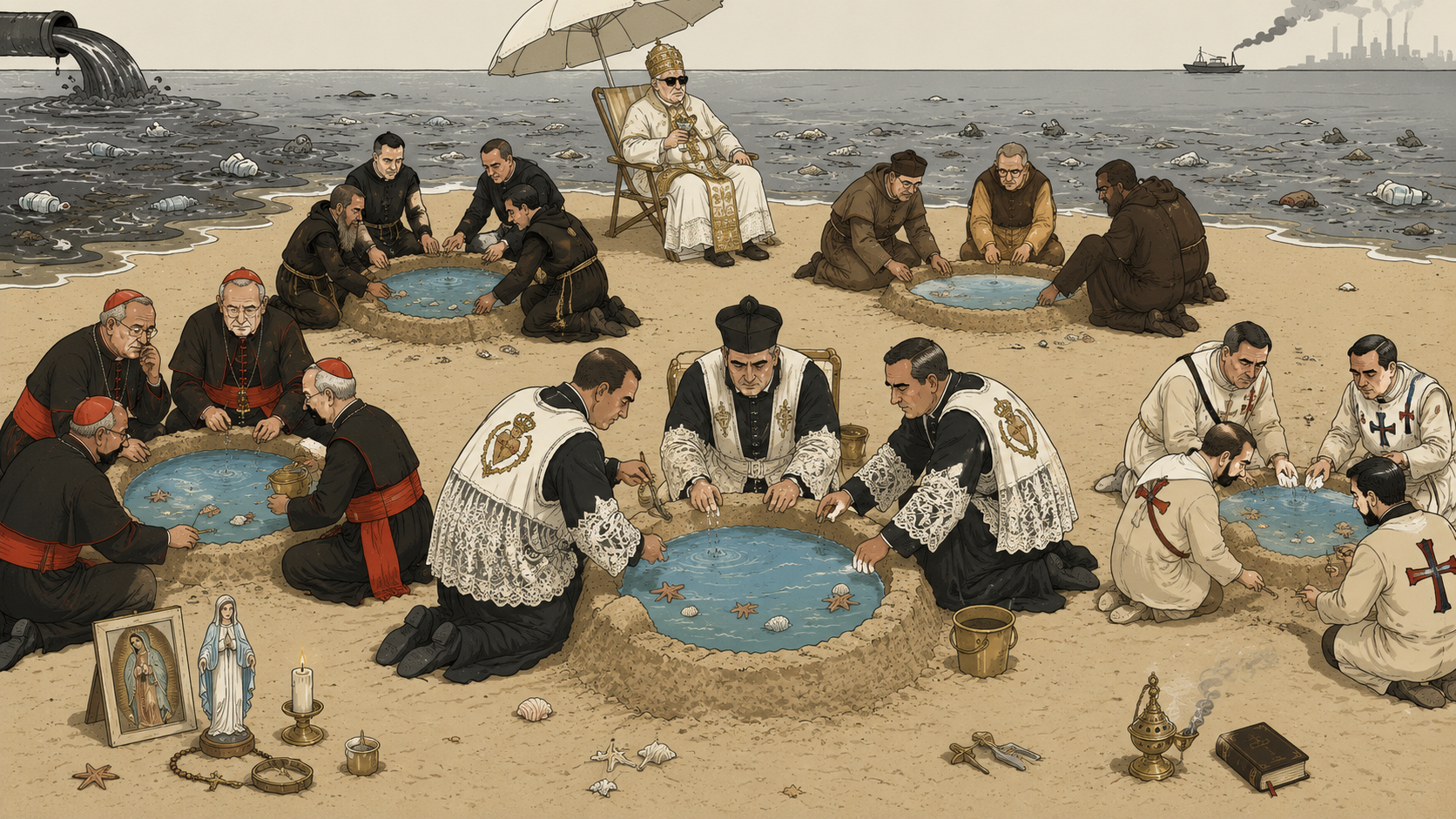
The polluted ocean in the image represents the crisis in the Church—confusion, scandals, doctrinal disputes, and genuine wounds that trouble many faithful Catholics. No serious observer can deny that these problems exist. Yet rather than remaining together to clean and restore the ocean, the various groups retreat to the shoreline and build their own miniature seas.
At first glance, these ponds appear peaceful and pure. But they are built on sand. They are small, isolated, and vulnerable. A single high tide can wash away what took years to construct. More importantly, the dangers that exist in the ocean do not disappear simply because one has dug a pond. Pirates, storms, hostile invaders, and other threats remain. A small pond has fewer resources, fewer defenders, and less resilience than the ocean from which it separated itself.
The image also highlights another reality: these groups do not even agree among themselves. One pond is not enough; soon there are many ponds. Some argue over doctrine, others over authority, others over liturgy, and still others over who possesses the true continuation of Tradition. The result is fragmentation. Each group becomes increasingly self-referential, and authority is reduced to whichever leader one chooses to follow. In practice, everyone risks becoming his own pope.
There is also no guarantee that these isolated groups will survive from one generation to the next. History is full of movements that appeared strong for a time but eventually fractured, shrank, or disappeared altogether. A community separated from the visible structures of the Church may preserve certain treasures, but it cannot guarantee its own future. It cannot guarantee unity. It cannot guarantee continuity. It cannot guarantee that the next generation will remain faithful.
This is the fundamental problem with abandoning the Church in order to build parallel structures. The Church is not merely a collection of like-minded Catholics. She is a visible society founded by Christ, possessing unity of faith, sacraments, and governance. The solution to a polluted ocean is not to create countless ponds. The solution is to help purify the ocean itself.
For that reason, there is nothing in the Church’s present crisis that can justify schismatic acts by the SSPX or any other traditionalist group. Legitimate concerns about doctrine, liturgy, or governance do not grant a right to act independently of the Church’s established authority. If traditional Catholics truly wish to preserve the Faith for future generations, they must seek to do so in visible unity with the successor of St. Peter.
The smarter path is not the construction of parallel seminaries, jurisdictions, tribunals, and ecclesial structures that function independently of Rome. The smarter path is to work for Tradition from within the Church: establish strong parishes, support faithful seminaries, promote sound catechesis, cultivate reverent liturgy, form holy families, publish orthodox teaching, encourage vocations, and respectfully advocate for authentic renewal while remaining in communion with the Pope.
Building a pond may feel safer. Cleaning the ocean is harder. But only the ocean was entrusted by Christ to Peter. If the goal is truly the salvation of souls and the transmission of the Faith to future generations, then the task is not to replace the Church with smaller alternatives, but to help restore her in unity, charity, and fidelity to the faith handed down through the ages.



Leave a Reply