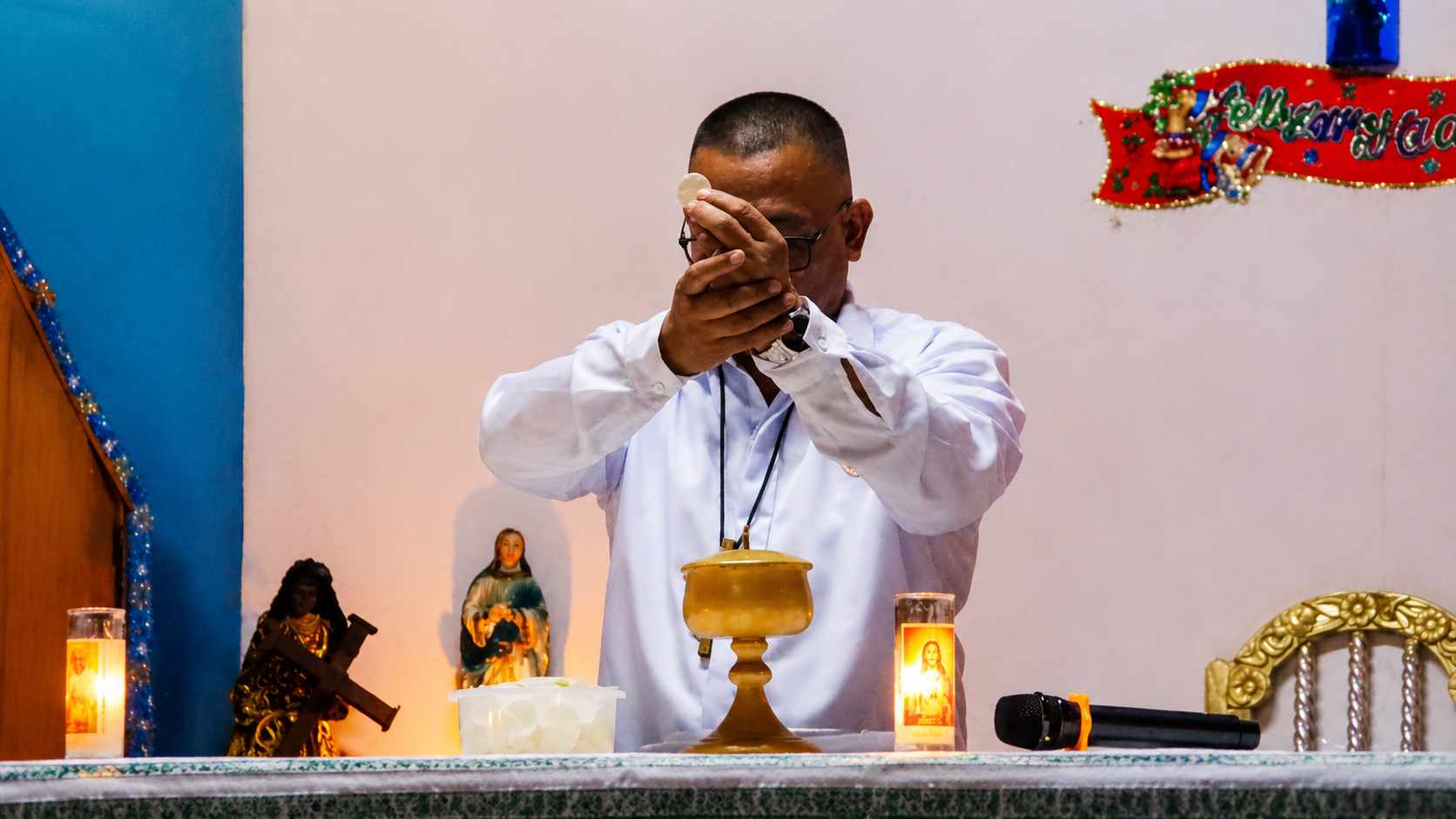
The featured image shows a layman elevating the Body of Christ as though he were an ordained priest, even though he is not. One would hope never to witness such a scene during Catholic worship. Unfortunately, this has become a reality in many parts of Asia and Latin America, where the shortage of priests has led to the widespread use of Communion services led by lay ministers. In fact, I grew up in communities where lay-led Communion services were a normal part of Catholic life due to the scarcity of priests.
This is especially true in remote villages where the faithful gather in small chapels. A single parish priest may be responsible for dozens of communities spread across difficult terrain. Many villagers consider themselves blessed if they are able to attend Holy Mass even once a month.
On Sundays and Holy Days of Obligation when a priest cannot be present, the faithful gather for a community prayer service. This is ordinarily led by a lay minister who has been appointed and authorized by the parish priest. Typically, this ministry has been entrusted to qualified men, although in some places women also fulfill this role.
The community prayer is not the Holy Mass, but it follows a structure that closely resembles it. As a result, the lay minister conducts much of the service, including delivering a reflection or “homily,” leading many of the prayers, and collecting the offertory. This resemblance can easily cause confusion between a community prayer service and the Holy Sacrifice of the Mass.
However, a significant portion of the Eucharistic Prayer is omitted, since only a validly ordained priest can consecrate the bread and wine into the Body and Blood of Christ. Holy Communion is then distributed using hosts that were consecrated previously by the parish priest during an earlier Mass.
The devotion of these faithful is deeply moving. Despite having limited opportunities to attend Mass, they continue to hunger for Christ in the Holy Eucharist. Their perseverance should inspire Catholics everywhere.
At the same time, this reality invites serious reflection. One example I have personally witnessed is the use of an ordinary plastic food container (see featured image), without even a linen covering, to store the Sacred Hosts. Although such a practice may arise from necessity, limited resources, or a lack of proper liturgical formation rather than bad intentions, it weakens belief in the Real Presence. If the Eucharist appears to be treated like ordinary food, it becomes much harder (especially for children, converts, and the poorly catechized) to understand that the container holds the Body, Blood, Soul, and Divinity of Jesus Christ.
The treatment of the Holy Eucharist is not the only concern. These community prayer services often imitate the most informal expressions of the protestantized modern Novus Ordo: guitars and contemporary music, Communion in the hand, casual “homilies” mixed with jokes, and an overall atmosphere that can weaken the Sense of the Sacred. This is not a criticism of poor villages, whose faith is often admirable, nor of the Novus Ordo itself when celebrated reverently. Rather, it highlights the urgent need for more holy and well-formed priests who can foster authentic Eucharistic reverence and faithfully hand on the Church’s liturgical tradition.
The Church has always taught that external signs of reverence help form interior faith. Sacred vessels, clean linens, genuflections, silence, proper reservation of the Blessed Sacrament, and careful handling of the Sacred Hosts are not mere decorations or empty rituals. They proclaim with actions what Catholics profess with words: that the Eucharist is truly Our Lord Himself. Reverence is therefore not a luxury reserved for wealthy parishes; it is an expression of faith that every Catholic community deserves, regardless of its economic circumstances.
Sometimes I think about donating a ciborium or a proper pyx to chapels that lack them. Such acts of charity are certainly worthwhile. Yet they address only one small part of a much larger problem. The deeper issue is the shortage of priests and the need for better pastoral care in these remote communities. A beautiful vessel is important, but even more important is the presence of a holy priest who can celebrate the Holy Sacrifice of the Mass, teach sound doctrine, ensure that the Blessed Sacrament is cared for properly, and lovingly form the faithful in Eucharistic devotion.
The scarcity of priests is becoming increasingly serious in many parts of the world. As the number of Catholics continues to grow in many regions while the number of priests does not keep pace, more communities are left with infrequent access to the sacraments. This places tremendous burdens on the clergy and increases the likelihood that liturgical shortcuts or inadequate practices will develop through necessity rather than malice.
For this reason, the Church needs not only more priests but also holy, faithful, and well-formed priests—men who love the Eucharist, celebrate the sacred liturgy with reverence, and help their people recognize the immense gift entrusted to them.
The Eucharist is the source and summit of the Christian life. Every Catholic, whether in a great cathedral or a humble village chapel, deserves to encounter Our Lord in an atmosphere that reflects the sacred mystery taking place.




Leave a Reply