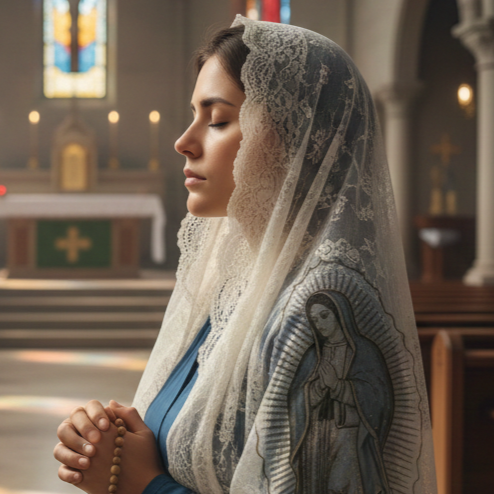
In the Holy Sacrifice of the Mass, active participation is often misunderstood as mere external activity—singing, responding, or movement. In truth, it is primarily an interior act of the heart. It calls for disciplined receptivity and intentional attentiveness, by which the soul empties itself in order to encounter more deeply the divine mystery.
In a 2021 interview with Patrick Coffin, Dr. Janet Smith discusses her move toward the Traditional Latin Mass (TLM). During the conversation, they touched on several topics, including active participation. What follows is my transcript of their perspective of this topic.
Patrick Coffin: I want to direct people to your website, www.janetsmith.org. You have a tab called “Latin,” and it’s some simple tutorials on how to get through your first Latin Mass.
My friend Derya Little—who was raised in an atheist, Muslim home in Turkey, of all places and contexts—has a terrific little, thin book called A Beginner’s Guide to the Traditional Latin Mass, and her advice for people who have no exposure whatsoever is just: go without a Missal. Do not try to follow along; just exist there. Let it wash over you. It’s a different timing. There are more collect prayers. No one’s in a hurry.
Janet Smith: Yeah, I have there on the website the Latin Mass… I think it helps a lot of people when they’re going to Latin Mass… I tell people it’s a lot more like going to Adoration than it is like going to the Novus Ordo. There’s so much participation—up and down, singing responses. On this, it’s much like just going and being receptive; just being receptive to whatever God wants to give you, and at the same time making this huge offering of yourself.
The Confiteor, I think it is said three times during the Traditional Latin Mass. That gives you a sense that we’re really there, and we know that we are sinners, and then we also know that we are redeemed, and we pray for all our dead and the living and all of this. And so you just feel over and over again like, “I’m here because I’m a sinner, but I’m here because I’m saved, and I’m here to try to save everybody else too, with all my prayers.” And it—I just love it.
My friends, they felt very bad because they couldn’t follow the Latin. I said, “You know, I have a PhD in Latin and Greek, and if I didn’t have a Missal, I couldn’t follow the Latin.” I said, “I know almost no one who hasn’t been going for 20 years and kind of memorized it.”
First of all, the priest is supposed to say a large number of the prayers quietly. So how could you follow, anyway? Because he’s saying them quietly.
I don’t advise following the whole Mass in Latin. It’s quite impossible… When you do the Sanctus or Agnus Dei, the choir just lingers with that, and the priest just goes right on.
Patrick Coffin: That’s something at Franciscan University—I did a whole seminar after seminar on the documents of Vatican II, and one of them that I enjoyed the most was Sacrosanctum Concilium and its emphasis on active participation.
There’s more than one way to understand that. If you’ve only been raised in your typical suburban Novus Ordo Mass, “active participation” means clapping, the gestures—almost like the Kiss of Peace is the most important thing. It’s kind of horizontalized.
That’s not what active participation really means. It’s more of a thing of the heart. It’s an intentionality thing where you’re entering into the mysteries…
Janet Smith: I think the notion of “active participation” is never defined, which makes it, honestly, just about worthless; because if it’s such an important concept, you have to define it…
When I go to the Traditional Latin Mass, I enter into this state of serenity that’s just amazing.
I’ve done a lot of Adoration, which everybody knows, whenever you start trying to pray for an hour, Adoration is hard. Your mind goes everywhere. You want something to read. You’re looking at your watch to see how much time you’ve got. It really is a result of a lot of discipline of your intellect and your passions to really be able to be receptive.
I think the “active participation” is one that translates into amazing receptivity—that God is going to be talking to you in some way during this Mass and wants a response from you. That’s the active participation…
It’s not a matter of joining in or standing up or kneeling. Those things take place, but the thing is really to be in this very reverential state. Understand the Sacrifice is being made, join yourself to that Sacrifice, and see what God wants of you.
Not “active” in the sense of running around a track, but active in the sense of really collecting my powers and, in a sense, putting them to rest. And just say, “Okay, God, I’ve done it now—the kenosis. I’ve opened up. I’ve emptied myself for you to be here.”